
Basics
Top Header Bar:

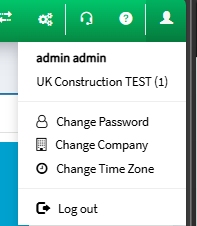
The top header bar shows the logged in user from the top-right corner. When clicking on the logged in user you have the option to Change Password or Logout:
The menu button allows you to minimize and maximize the left-pane menu:

Left Pane Menu:
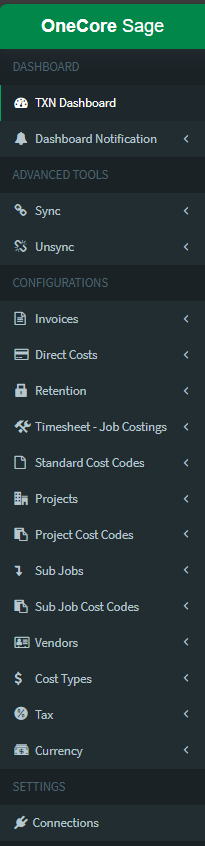
The left pane menu allows you to view and set up your company’s integration settings between Procore and Sage Intacct. The menu options include:
- Transaction Dashboard
- Advanced Tools
- Sync: Direct Cost, Commitment Claim, Head Contract Claim, Claim Payment
- Unsync: Direct Cost, Commitment Claim, Head Contract Claim, Claim Payment
- Configurations
- Invoices
- Direct Costs
- Retention
- Timesheet – Job Costings
- Standard Cost Codes
- Projects
- Project Cost Codes
- Sub Jobs
- Sub Job Cost Codes
- Vendors
- Cost Types
- Tax
- Currency
- Settings
- Connections
- Help
- KB Articles
- Contact Support
Transaction Dashboard:
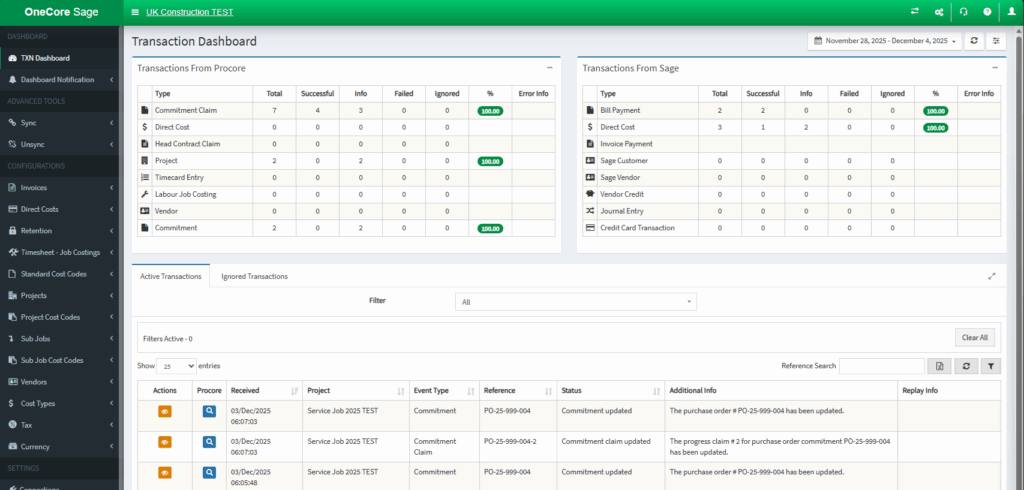
The dashboard allows you to view any mapping errors as well as failed transactions, if the transaction isn’t going through.
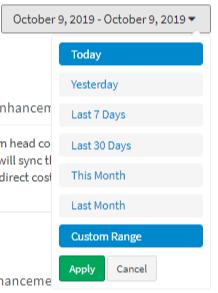
You can filter the overall transactions by the date range:
Invoices:
Invoices ha: General Settings, Head Contract and Commitment Settings.
General Settings:
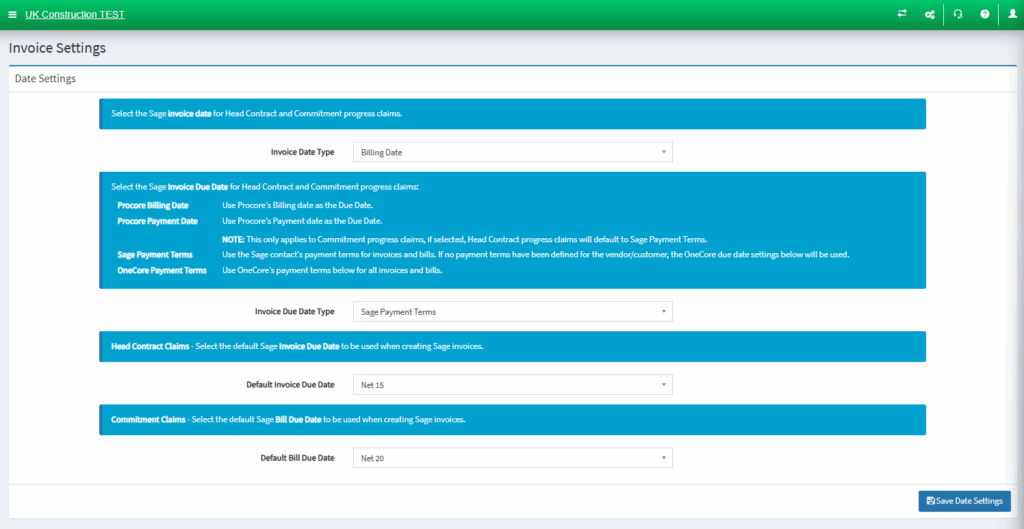
- Invoice Date Type: Set Sage invoice date for Head Contract and Commitment progress claims
- Invoice Due Date Type: Set Invoice Due Date for Head Contract Claim and Commitment Progress Claim
- Default Invoice Due Date: Set the default Sage Invoice Due Date to be used when creating Sage invoices
- Default Bill Due Date: Set the default Sage Bill Due Date to be used when creating Sage Bills
Head Contract Settings:
In “General Settings“:

- Prefix Contract Number: Enabling this option will prefix the Progress Claim Number with the Contract Number as the generated Sage invoice Reference Number.

- Head Contract Attachment Folder: Set the attachment folder for head contract in Sage Intacct.
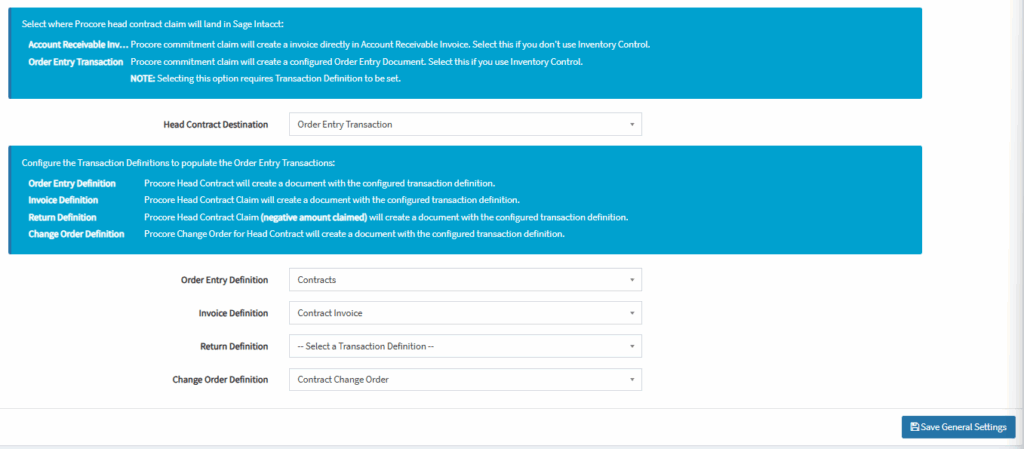
- Head Contract Destination: Select where Procore Head Contract will be populated in Sage.
- Order Entry Definition: Procore Head Contract will create a document with the configured transaction definition.
- Invoice Definition: Procore Head Contract Claim will create a document with the configured transaction definition.
- Return Definition: Procore Head Contract Claim (negative amount claimed) will create a document with the configured transaction definition.
- Change Order Definition: Procore Change Order for Head Contract will create a document with the configured transaction definition.
Click “Save General Settings” to save the configuration.
Commitment Bill Configurations:
In “General Settings“:
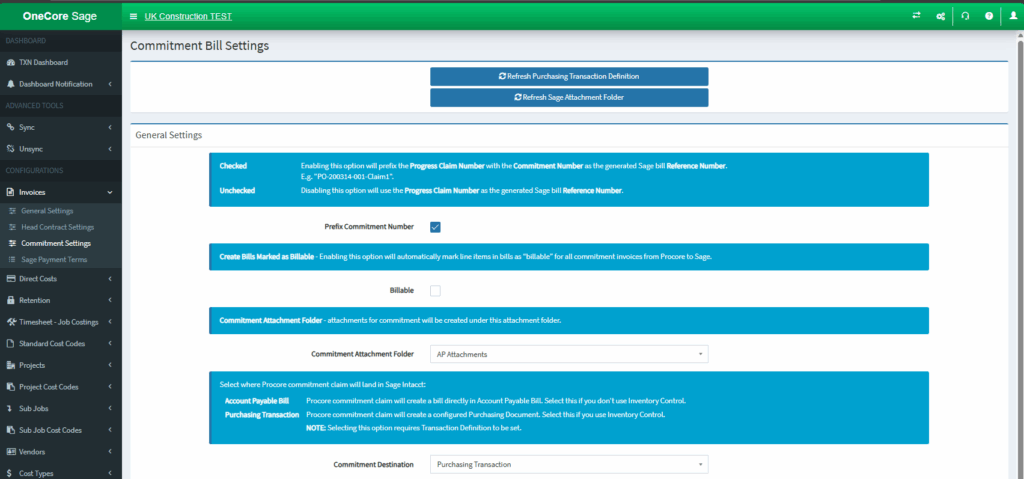
- Prefix Commitment Number: Set the prefix of Progress Claim Number with the Commitment Number upon generating Sage Bill’s Reference Number
- Billable: Enabling this will automatically mark line items in bills as “billable” for all commitment invoice from Procore to Sage Intacct
- Commitment Attachment Folder: Set the attachment folder for commitment in Sage Intacct.
- Commitment Destination: Select where Procore Commitment will be populated in Sage.
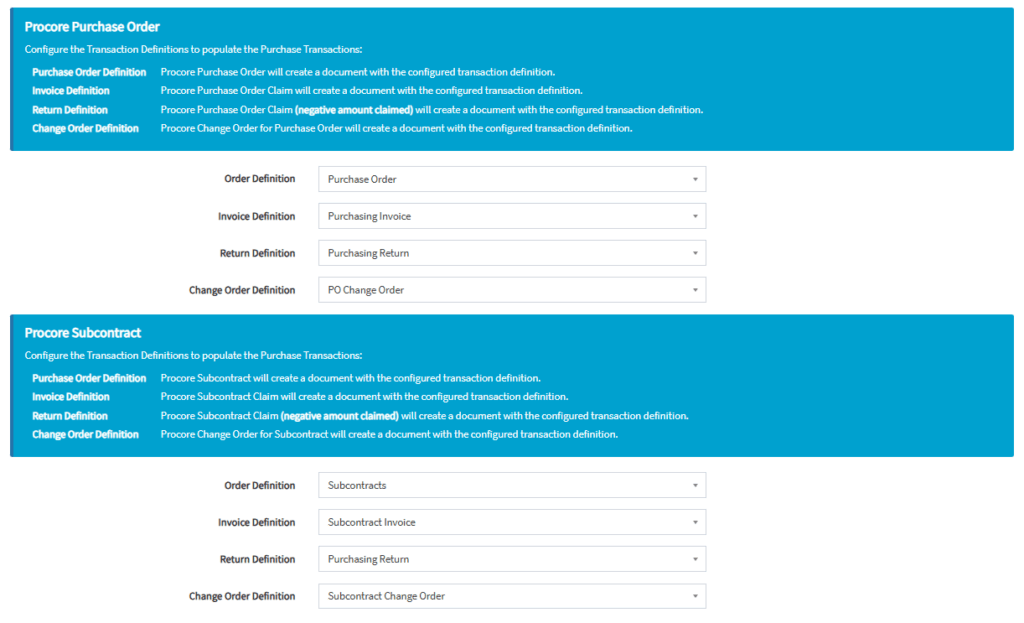
- Purchase Order Definition: Procore Purchase Order/Subcontract will create a document with the configured transaction definition.
- Invoice Definition: Procore Purchase Order/Subcontract Claim will create a document with the configured transaction definition.
- Return Definition: Procore Purchase Order/Subcontract Claim (negative amount claimed) will create a document with the configured transaction definition.
- Change Order Definition: Procore Change Order for Purchase Order/Subcontract will create a document with the configured transaction definition.
Click “Save General Settings” to save the configuration.
QBO Payment Terms:
In “Payment Terms Setting“:
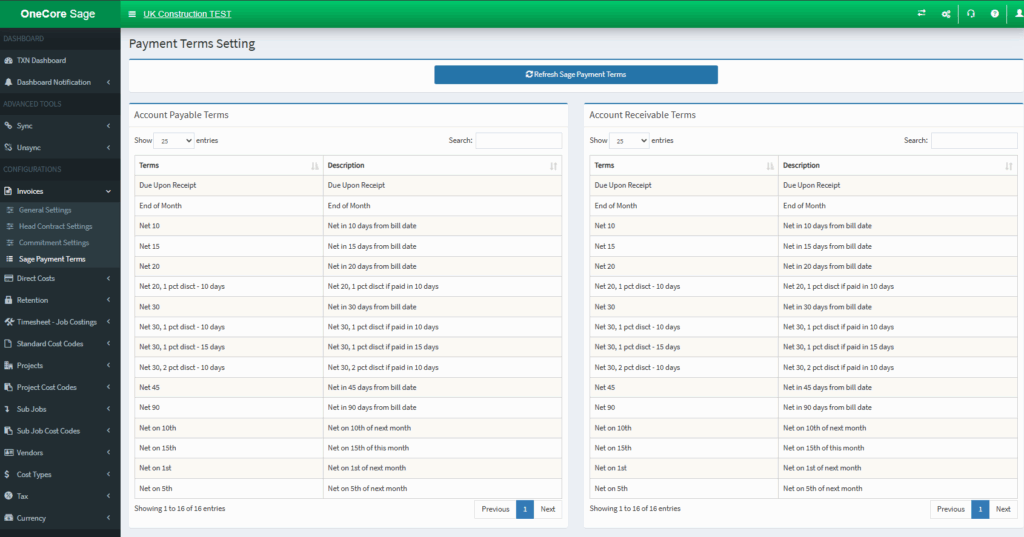
- Refresh QBO Payment Terms: Synchronizing latest payment terms data from Sage Intacct
In the table above shows the latest payment terms data from Sage Intacct since the last refresh that is initiated.
Direct Costs:
Direct Cost Settings:
In “General Settings“:
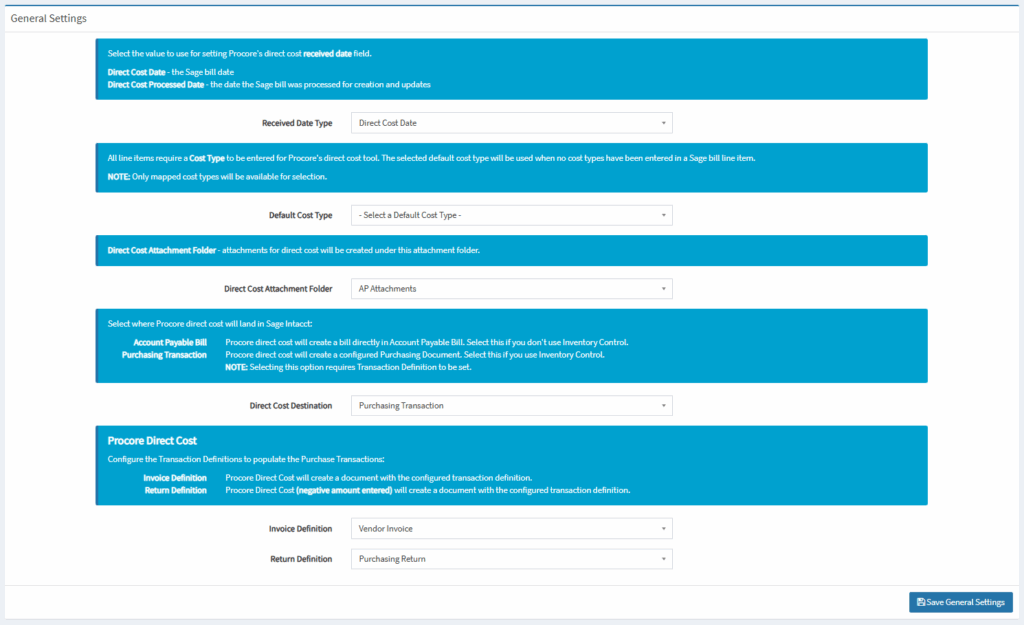
- Received Data Type: Set the value for Procore’s direct cost received date field
- Default Cost Type: Set the value for default cost type when no cost types has been selected upon generating Sage bill’s line item
- Direct Cost Attachment Folder: Set the attachment folder for direct cost in Sage Intacct.
- Direct Cost Destination: Select where Procore Direct Cost will be populated in Sage.
- Invoice Definition: Procore Direct Cost will create a document with the configured transaction definition.
- Return Definition: Procore Direct Cost (negative amount entered) will create a document with the configured transaction definition.
Click “Save General Settings” once you have finalized the configuration.
Direct Cost Transaction Types:
In “Enable Transaction Types“:
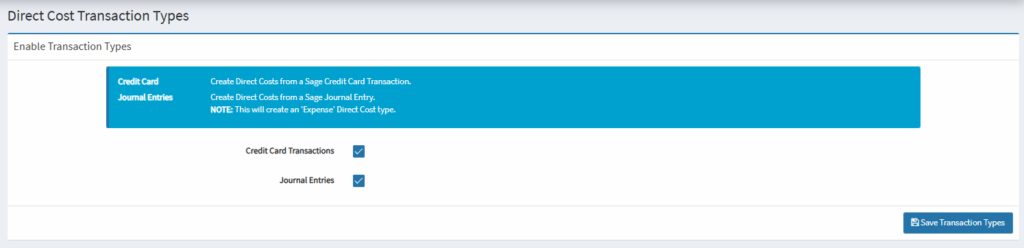
- Credit Card Transactions: Create Direct Cost from a Sage Credit Card Transaction
- Journal Entry: Create Direct Cost (Expense) from a QuickBooks Journal Entry
In “Manual Journal Settings“:
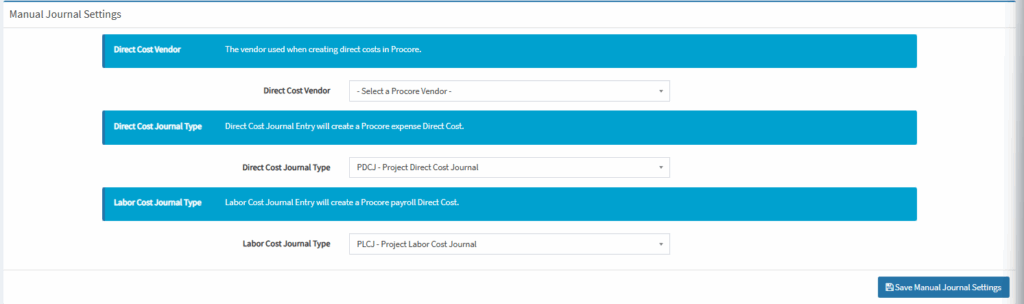
- Direct Cost Vendor: Set the vendor when creating direct costs in Procore
- Direct Cost Journal Type: Set the journal type for Direct Cost Journal Entry
- Labor Cost Journal Type: Set the journal type for Labor Cost Journal Entry
Retention:
Retention Settings
In “General Settings“:
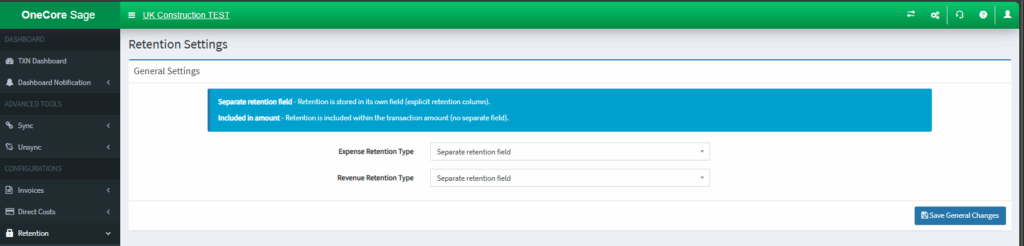
Retention Type:
- Expense Retention Type: Set how the retention is display in Sage Purchasing Transactions
- Revenue Retention Type: Set how the retention is display in Sage Order Entry Transactions
Standard Cost Codes:
Standard Cost Codes has four options: General Settings, Expense Mapping, Revenue Mapping, Expense Cost Division.
General Settings:
General Settings allows you to update the Procore cost code and QuickBooks account lists in OneCore, as well as set Expense account types to make the account visible for expense mapping.
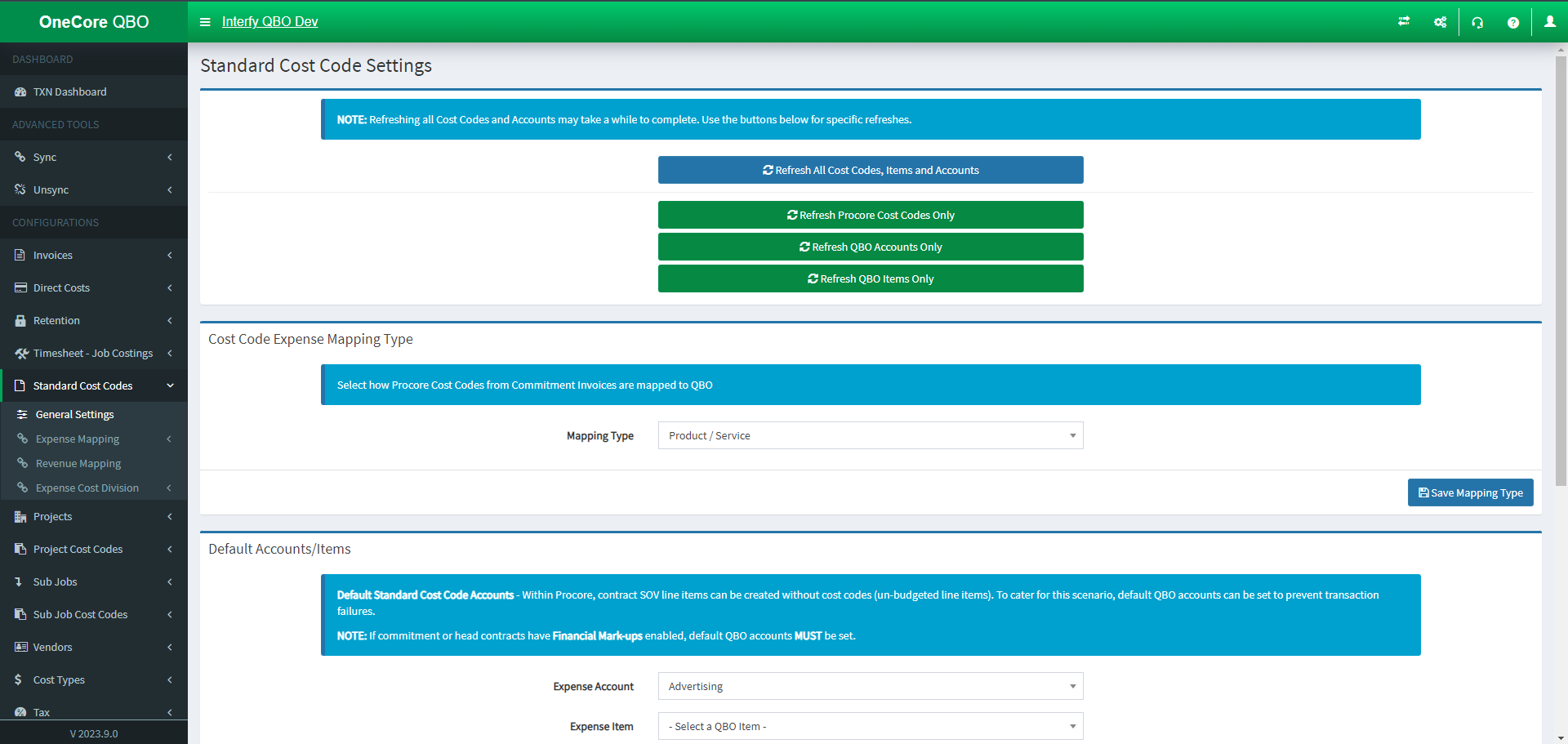
Refresh Code Code:

- Refresh All (Procore & QuickBooks)
- Refresh Procore Cost Codes Only (Procore)
- Refresh Sage Cost Codes Only (Sage)
- Refresh Sage Accounts Only (Sage)
- Mapping Type: Set Category or Product / Service upon generating QuickBooks Bill
Click ‘Save Mapping Type’ when you finalised your selection.
Account Mappings:
Toggle cost code mappings to additional in the Sage account types:

- Revenue Accounts
- Asset Accounts
- Liability Accounts
- Equity Accounts
Expense Mapping:
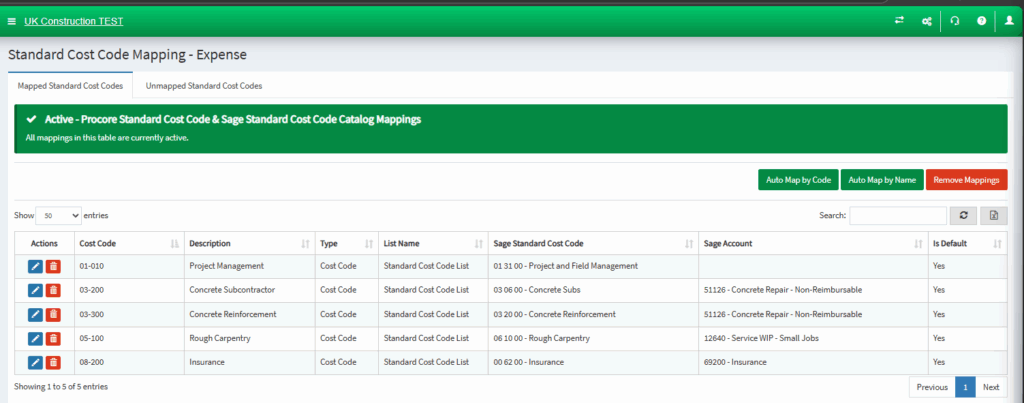
Expense Mapping allows you to:
- Auto-map Procore cost codes to Sage Cost Code by name or code
- Delete established mapping
- Manually map them from unmapped cost codes.
Standard Cost Code Mapping – Expense – Account
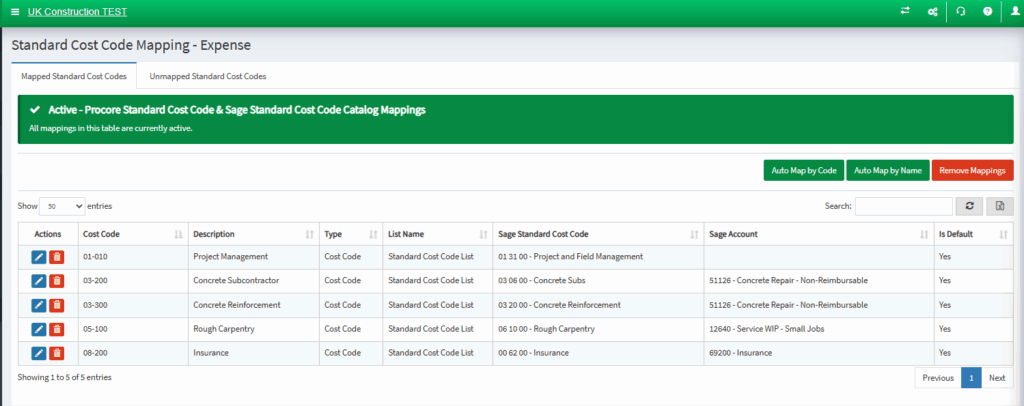
- Apply to All feature: Apply QuickBooks Expense Account to all unmapped Standard Cost Codes
- Mapped Standard Cost Codes: Active mappings
- Unmapped Standard Cost Codes: Set your cost code mapping here
Revenue Mapping:
Revenue Mapping allows you to
- Auto-map Procore cost codes to Sage Cost Code by name or code
- Delete established mapping
- Manually map them from unmapped cost codes.
Expense Cost Division (Optional):
This mapping only be required if there are unbudgeted commitments created with an SOV containing cost divisions.
Expense Cost Division allows you to:
- Manually map Procore Cost Divisions to Sage Cost Code
- Delete established mapping
Standard Cost Code Division Mapping – Expense – Cost Code
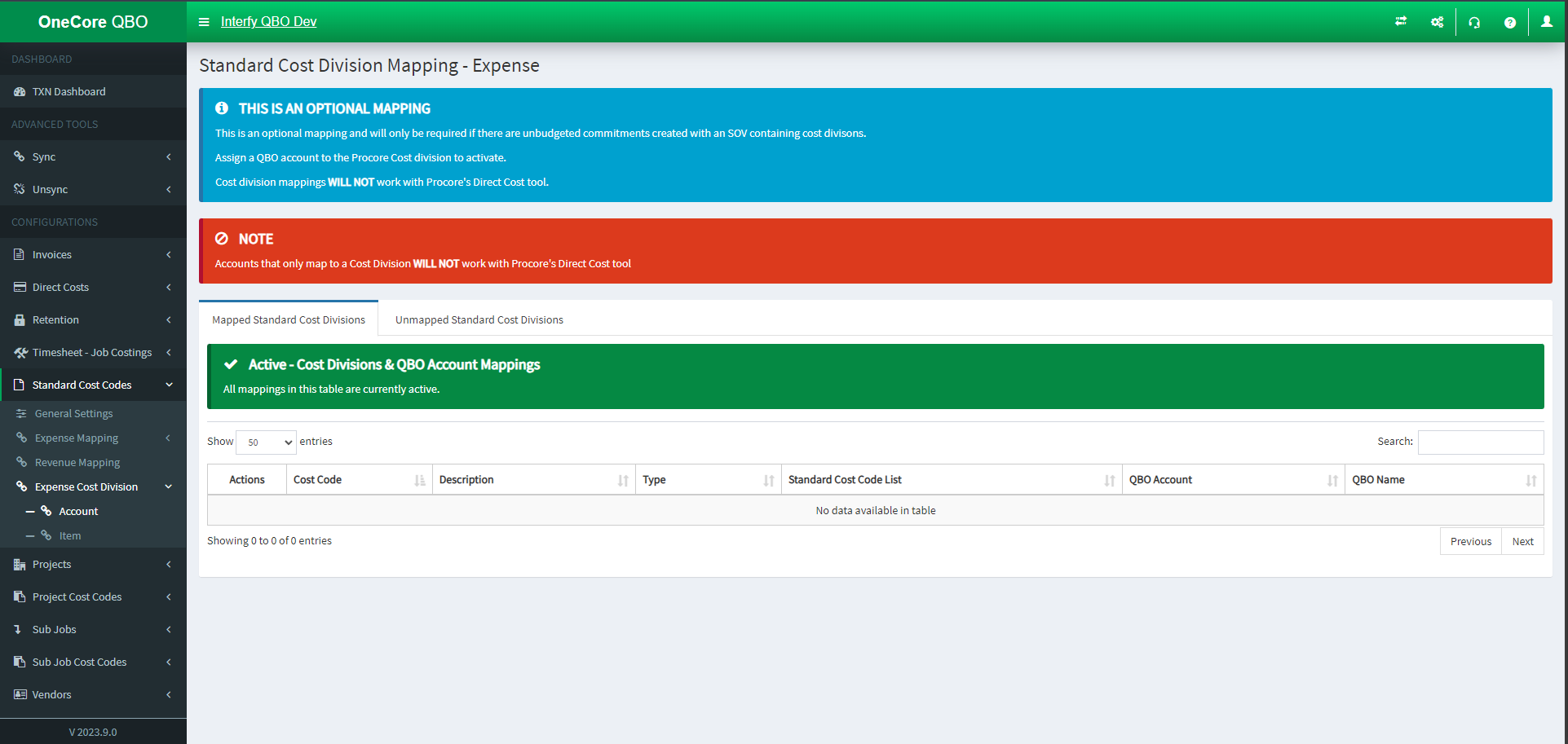
- Mapped Standard Cost Divisions: Active mappings
- Unmapped Standard Cost Divisions: Set your cost code division mapping here
Projects:
Projects has four options: General Settings, Project Mapping
General Settings
General Settings allows you to update the Procore Projects and Sage Projects lists in OneCore, and configure General Settings.
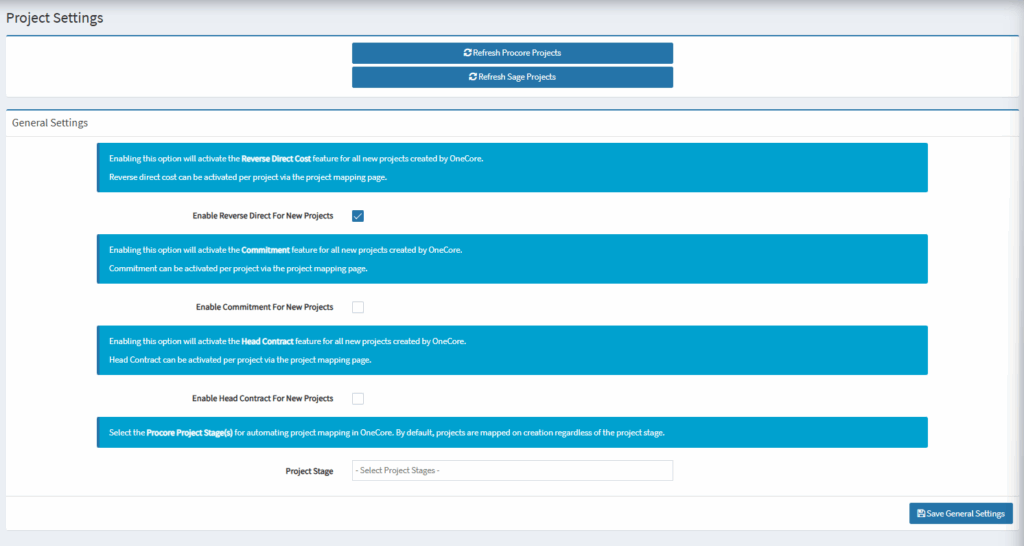
Refresh Projects:

- Refresh Procore Projects (Procore)
- Refresh Sage Projects (Sage)
General Settings:
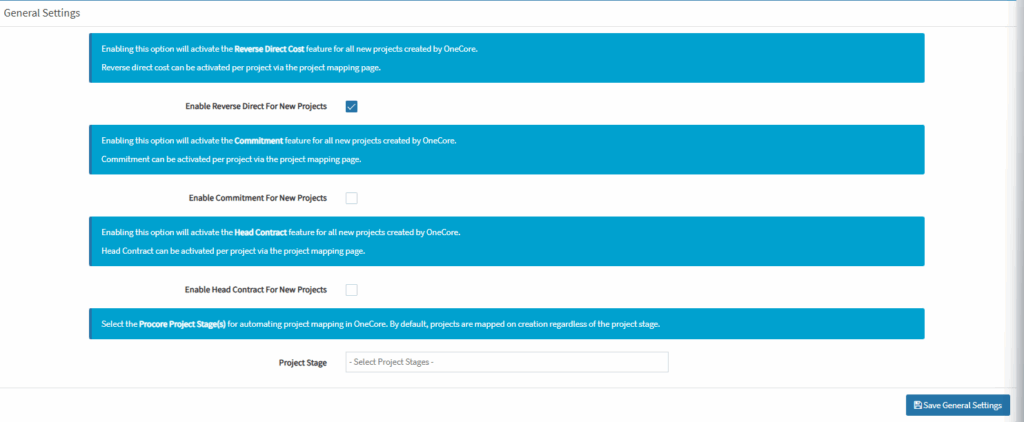
- Enable Reverse Direct For New Projects: Activate/deactivate the Reverse Direct Cost feature for all projects created by OneCore
- Enable Commitment For New Projects: Activate/deactivate the Commitment feature for all projects created by OneCore
- Enable Head Contract For New Projects: Activate/deactivate the Head Contract feature for all projects created by OneCore
- Project Stage: Automating project mapping in OneCore
Project Mapping:
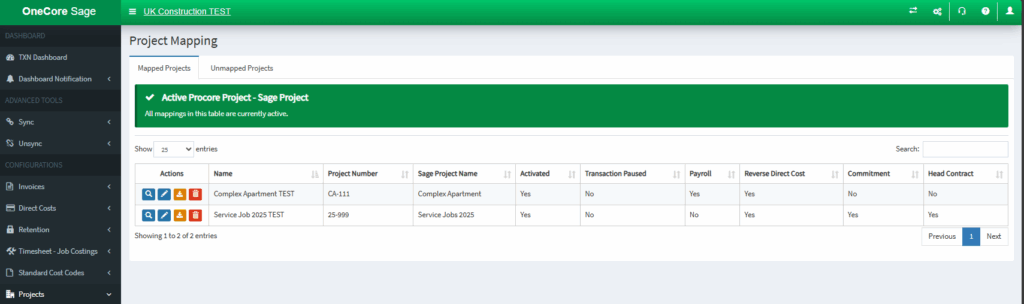
- Mapped projects: Active mappings
- Unmapped Projects: Set your project mapping here
Project Cost Codes:
Project Cost Codes has four options: Expense Mapping, Revenue Mapping, Default Expense Accounts, Default Expense Items, Default Revenue Items.
Expense Mapping
Expense Mapping allows you:
- Select a project to view it’s current cost code mappings
- Apply to All: Create mappings for all cost codes of the selected project
- Auto-map Procore cost codes to Sage expense accounts on Selected Project
- Delete established mapping
- Manually map them from unmapped cost codes
Project Cost Code Mapping – Expense – Sage Cost Code
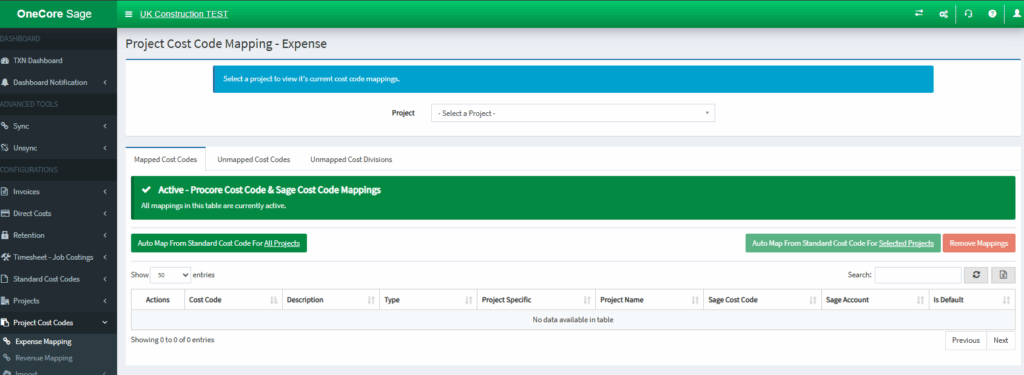
- Select a project to view it’s current cost code mappings
- Mapped Standard Cost Codes: Active mappings
- Unmapped Cost Codes: Set your cost code mapping here
- Unmapped Cost Divisions: Set your cost division mapping here
Revenue Mapping (HCC)
Revenue Mapping allows you:
- Select a project to view it’s current cost code mappings
- Auto-map Procore cost codes to QuickBooks Revenue Item on Selected Project
- Delete established mapping
- Manually map them from unmapped cost codes
Project Cost Code Mapping – Revenue Mapping
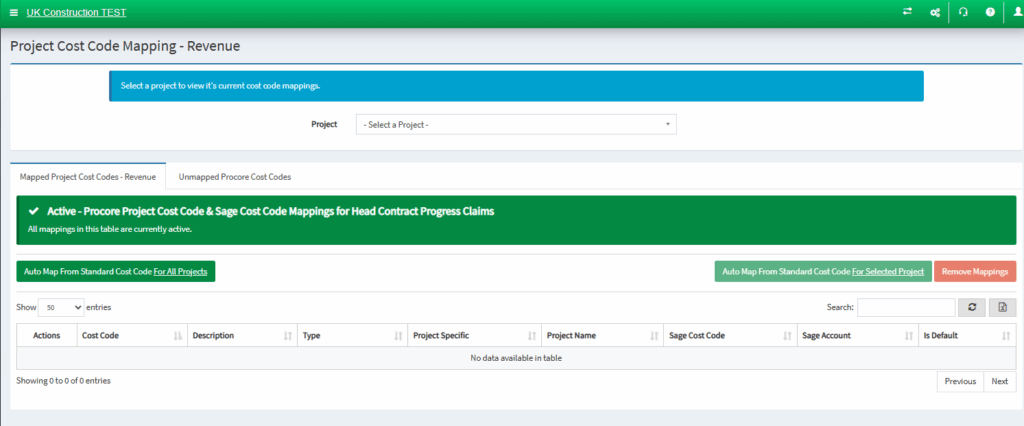
- Select a project to view it’s current cost code mappings
- Mapped Procore Cost Codes – Revenue: Active mappings
- Unmapped Procore Cost Codes: Set your cost code mapping here
Sub Jobs:
Projects has four options: General Settings, Sub Job Mapping
General Settings
General Settings allows you to:
- Update the Procore Project Sub Job and Sub Job Cost Codes lists in OneCore
Sub Job Settings:

- Refresh Procore Sub Jobs (Procore)
- Refresh Procore Sub Job Cost Codes (Procore)
Sub Job Mapping
Sub Job Mapping allows you to:
- Establish Procore Sub-Job mapping
Sub Job Mapping:
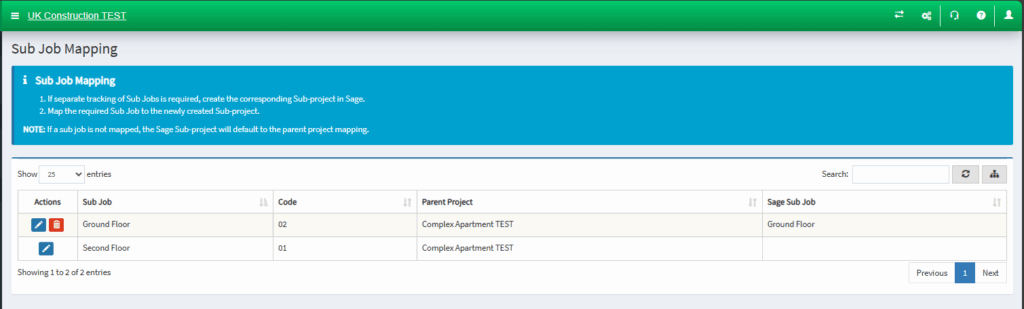
- Pencil Icon: Click the particular icon to establish the account’s mapping under a project
Sub Jobs Cost Codes:
Sub Job Cost Codes has four options: Expense Mapping, Revenue Mapping
Expense Mapping
Expense Mapping allows you to:
- Auto-map Procore cost codes to Sage Cost Codes
- Delete established mapping
- Manually map them from unmapped cost codes.
Sub Job Cost Codes – Expense Mapping
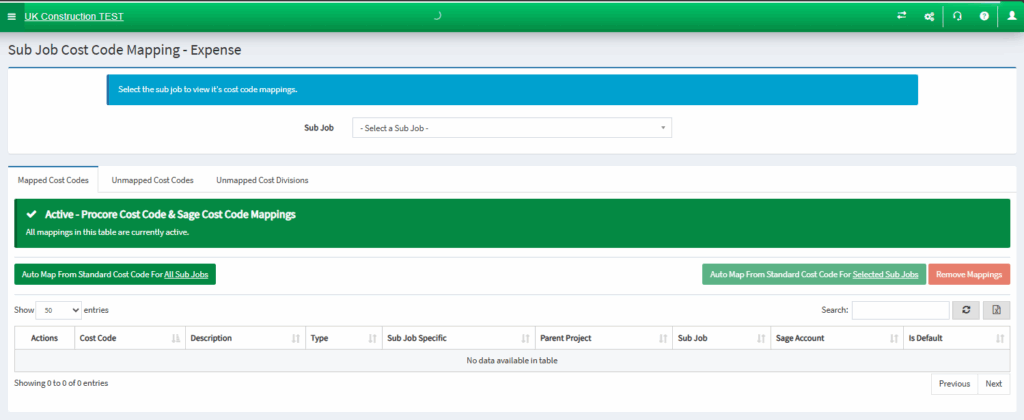
- Mapped Cost Codes: Active mappings
- Unmapped Cost Codes: Set your cost code mapping here
- Unmapped Cost Division: Set your cost code division here
- Mapped Cost Codes: Active mappings
- Unmapped Cost Codes: Set your cost code mapping here
- Unmapped Cost Division: Set your cost code division here
Revenue Mapping
Revenue Mapping allows you to:
- Auto-map Procore cost codes to Sage Cost Code
- Delete established mapping
- Manually map them from unmapped cost codes.
Sub Job Cost Codes – Revenue Mapping
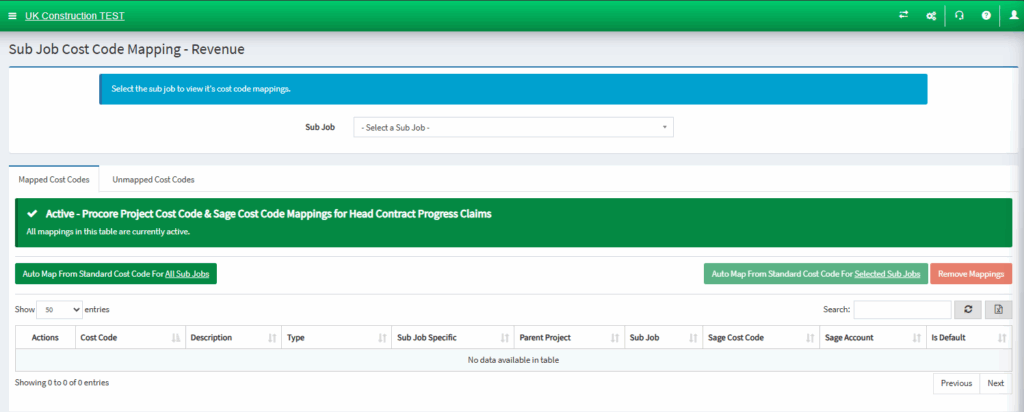
- Mapped Cost Codes: Active mappings
- Unmapped Cost Codes: Set your cost code mapping here
Feature Part 2 (Link)
In Part 2, we will cover:
- Vendor
- Cost Types
- Tax
- Custom Fields
Link to part 2